

By Rolf Bona & Sabina Crameri-Hamel
The requirements for emergency call systems for seniors vary considerably depending on the living environment, whether in a senior apartment or a nursing and care home. Numerous factors play a role, including residents’ health, the availability of care staff, costs, and technological requirements.
A differentiated assessment of these aspects is essential in order to select solutions that meet not only the needs of users but also those of operators:
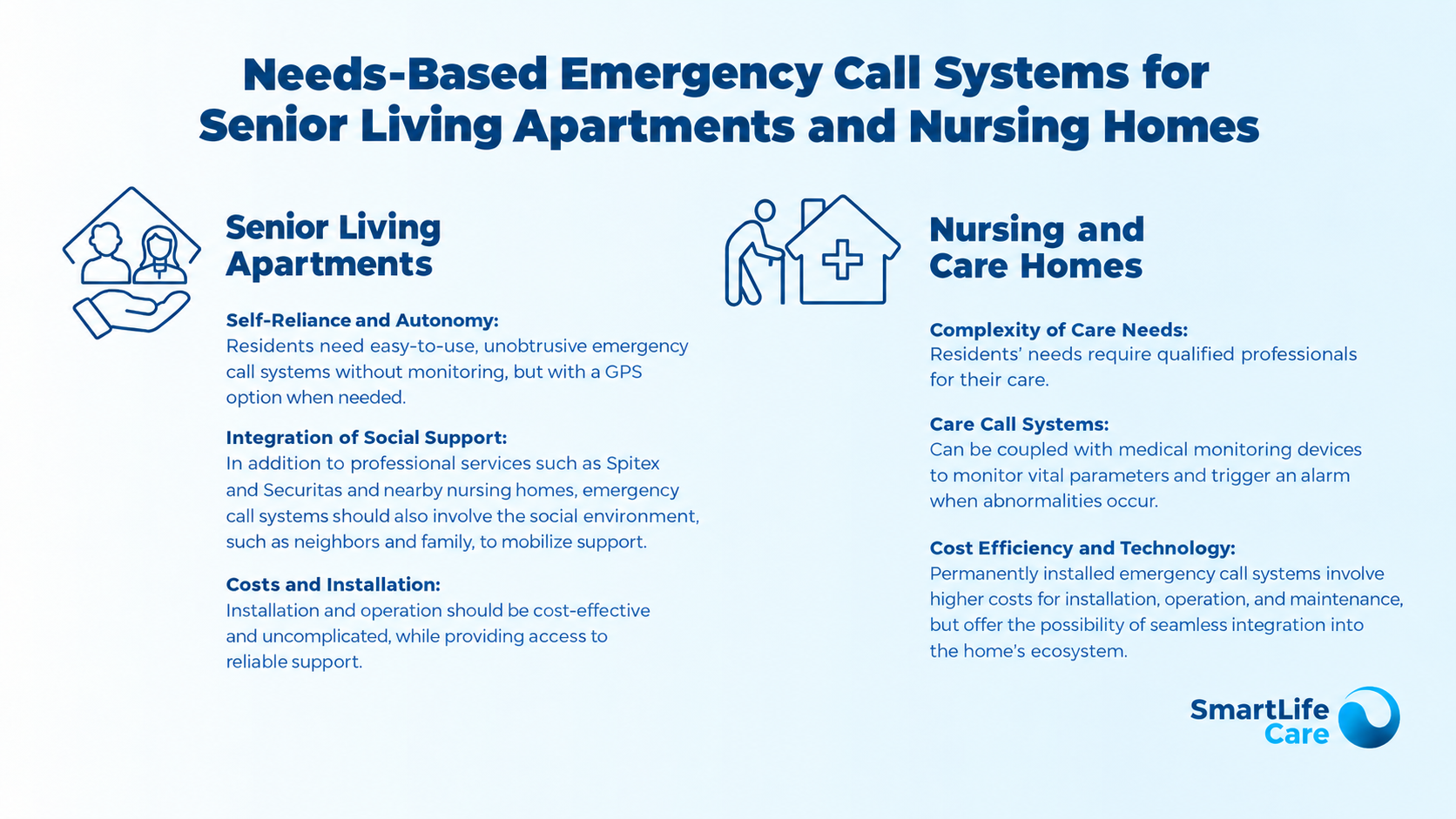
Nursing and Care Homes
Complexity of care needs: Nursing and care homes are predominantly home to older people with complex medical and care needs. This requires a larger number of qualified professionals, including nurses, care assistants, and physicians. Due to the shortage of skilled staff, nursing homes are increasingly relying on technological solutions to make the care and monitoring of residents more effective. In addition to traditional call functions, alarm systems in nursing homes can be connected to medical monitoring devices to track residents’ vital parameters, such as heart rate, activity and inactivity, sleep, and more, and trigger an alarm when abnormal readings are detected.
Professional care and intervention: Nursing homes have qualified care staff who can respond quickly and competently in an emergency. Emergency call systems should support these professionals in their work and provide them with effective tools for responding to emergencies. At the same time, the systems should offer operators simple and intuitive administration, helping to minimise workload and increase efficiency.
Cost efficiency and technology: Despite higher initial investments, permanently installed emergency call systems in nursing homes offer a cost-effective solution in the long term. Modern technologies enable effective monitoring of residents and rapid intervention in emergencies. Operators benefit from a reliable, low-maintenance solution that allows them to make optimal use of their resources and ensure a high standard of care, as these systems are generally fully integrated.
Senior Apartments
Independence and autonomy: Seniors living in apartments often value their independence and want to remain self-sufficient for as long as possible. There is therefore a need for emergency call systems that are discreet and easy to use in an emergency without restricting residents’ independence. At the same time, these systems should enable operators to efficiently support residents in their daily lives and respond to individual needs.
Integration of social support: Senior apartments often benefit from a strong social network consisting of neighbours, friends, family members, or local home-care services. In addition to professional services, emergency call systems should be capable of involving this social network so that additional support can be mobilised in an emergency. This can reduce the burden on operators while improving residents’ quality of life.
Costs and installation: The installation of emergency call systems in senior apartments should be cost-effective and straightforward, providing both residents and housing operators with a flexible and efficient solution. At the same time, it is important that operators have access to reliable support and maintenance services to ensure smooth and dependable operation.
Conclusion
Overall, nursing and care homes as well as senior apartments need to design their alarm systems according to the resources available, the individual needs of residents, and staffing requirements. Shortages of care and support staff represent a major challenge for the care sector, and technological solutions can help improve care for older people while reducing the workload of care professionals.
However, it is important to recognise that the choice of the right alarm system depends on residents’ individual needs and the resources available to the facility. Particularly in nursing and care homes, permanently installed call systems can be a valuable solution for ensuring high-quality care and continuous monitoring. In senior apartments, on the other hand, where residents are generally more independent, cost-effective fixed and mobile personal emergency response systems offer a practical and economical solution. Given the high costs associated with nursing and care homes, it can also be financially beneficial for municipalities if seniors are able to remain in senior apartments for as long as possible before moving into a nursing and care home becomes necessary.

Rolf Bona
CEO and Head of Product Development at SmartLife Care AG | Expert in Personal Emergency Response Systems (PERS), Senior Safety Solutions and Telecare

Sabina Crameri
| Chief Marketing Officer, Head of Business Development and Deputy CEO at SmartLife Care AG | Expert in Personal Emergency Response Systems (PERS), Customer Insights, Gerontology and Ageing in Place |